Where to Start Rebuilding Your Life When Everything Feels Like Too Much

Updated: 5 days ago
Content note
This article discusses overwhelm and rebuilding after abuse, trauma, addiction, mental-health struggles, and major life disruption. It includes a brief safety and crisis-resource note.
When everything feels like it needs to change
There are seasons when it is not one problem making life feel heavy. It is everything at once.
Your responsibilities. Your thoughts. Your home. Your relationships. Your finances. Your health. The past you are still carrying and the future you are trying to build.
When every part of life seems to need attention, even deciding where to begin can feel impossible. You may make a long list, search for the perfect system, or promise yourself that tomorrow you will finally get everything under control. Then the list becomes another source of pressure.
I know how easy it is to look at the distance between where you are and where you want to be—and mistake that distance for failure. But rebuilding is not a test of how much you can fix at once. It is the process of creating enough safety and stability to take the next honest step.

Why a complete life plan may be the wrong first assignment
A detailed plan can be helpful when you have enough capacity, information, and support to use it. When you are overwhelmed, however, trying to design your entire future can add pressure before you have addressed what is making today feel unmanageable.
That does not mean planning is bad or that your goals do not matter. It means the first plan may need to be smaller than the life you eventually want.
Instead of asking, “How do I rebuild everything?” begin with questions that bring you back to the present:
Am I safe right now?
What has a real consequence if it is not handled soon?
What basic need is making everything else harder?
What would make the next 24 hours feel slightly more stable?
These questions do not solve your whole life. They help you find the part that needs your attention first.
Safety comes before productivity
If you are currently unsafe, rebuilding does not begin with productivity. It begins with safety.
In the United States, the National Domestic Violence Hotline offers free, confidential support 24 hours a day. Call 1-800-799-SAFE (7233), text START to 88788, or use the hotline’s secure online chat. If you are experiencing emotional distress or thinking about harming yourself, call or text 988 or use the 988 Lifeline chat. If you are outside the United States, contact the appropriate emergency, domestic-violence, or crisis resource where you live.
You do not need to solve every practical problem before asking for help. A safety plan, a trusted person, a professional resource, or one protected conversation may be the first piece of structure you need.
Begin with a baseline—not a transformation
When life feels chaotic, the goal is not to become a completely different person overnight. The goal is to establish a baseline: the smallest level of safety, care, and structure that helps life remain functional while you decide what comes next.
A baseline might mean taking prescribed medication, feeding yourself and your children, making one urgent phone call, keeping an important appointment, finding tonight’s safe place to sleep, or identifying which bill has the most immediate consequence.
This is not lowering your worth. It is matching the plan to your current capacity, resources, and circumstances.
Sometimes the task you expect from yourself is simply larger than what today can hold. Instead of asking, “What would the ideal version look like?” ask, “What is the smallest safe and functional version?”
The Phoenix Rebuilding Map
When you cannot tell where to begin, use four stages: Stabilize, Simplify, Support, and Strengthen. You do not have to complete one stage perfectly before touching the next. The map is a way to identify what needs the most care now.
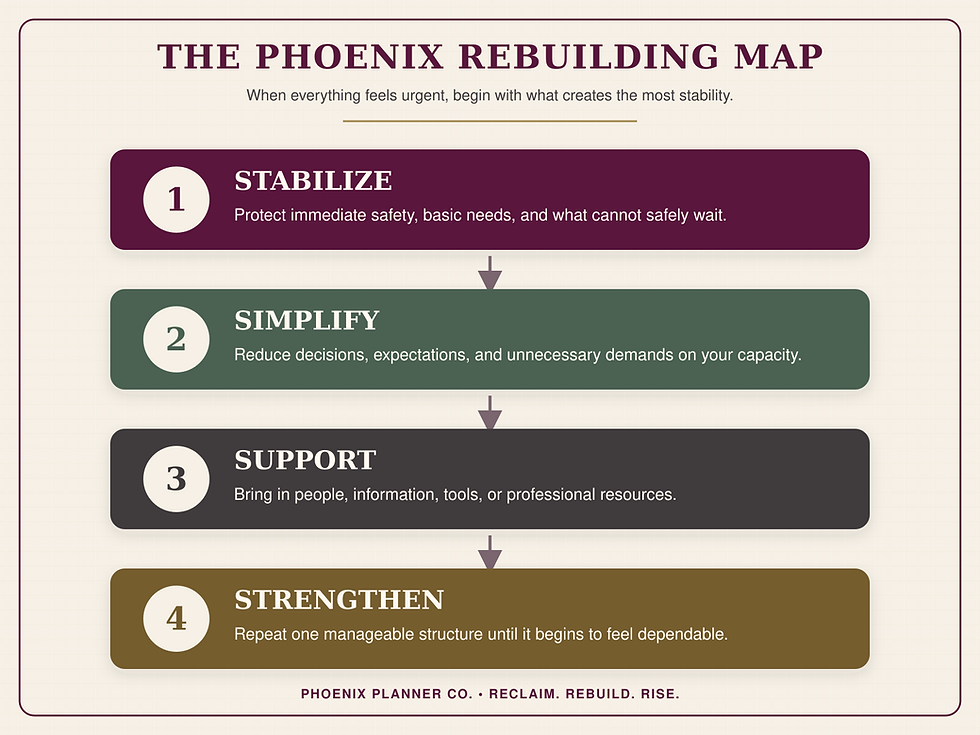
1. Stabilize what cannot safely wait
Stabilizing means addressing the needs or consequences that are most immediate. It is not the same as fixing every urgent-looking thing.
Start with the areas that protect safety and basic functioning:
Immediate physical or emotional safety
Food, water, medication, sleep, and shelter
Children’s immediate care and safety needs
Time-sensitive medical, legal, financial, housing, or employment matters
One task that prevents a larger problem tomorrow
If several things truly matter, choose the one with the nearest or most serious consequence. You are not deciding what matters forever. You are deciding what receives attention first.
2. Simplify what is demanding too much
Overwhelm is often made worse by the number of decisions, expectations, and unfinished tasks competing for attention. Simplifying creates room to think.
You might:
Postpone a nonessential decision
Choose a repeat meal, outfit, or routine
Reduce a task to its smallest safe and functional version
Remove one commitment that is not necessary right now
Write down a worry so you do not have to keep rehearsing it
Simplifying is not giving up. It is protecting your capacity so it can be used where it matters.
3. Support what should not rest on you alone
Rebuilding is personal, but it does not have to be solitary. Support can be emotional, practical, professional, financial, legal, medical, spiritual, or informational.
Ask yourself: What am I trying to carry alone because I believe I should be able to handle it?
Support might look like:
Asking someone to sit with you while you make a difficult call
Requesting specific help with transportation, childcare, paperwork, or a meal
Speaking with a therapist, advocate, attorney, doctor, recovery support, or community organization
Using a checklist, planner, template, reminder, or automatic payment to hold information outside your head
Telling one trustworthy person what you actually need instead of saying, “I’m fine”
Needing support is not evidence that you are incapable. It is evidence that you are a person rebuilding within real limits and real circumstances.
4. Strengthen one structure you can return to
Once the most immediate pressure has eased, choose one small structure to repeat. The purpose is not to create a perfect routine. It is to give yourself something dependable to return to.
That structure could be:
A five-minute evening reset
One place for essential papers
A short morning check-in
A weekly money review
A default plan for low-capacity days
A written list of who to contact when a certain problem happens
Start with one structure. Let it become familiar before you add another. Stability grows through repetition, not intensity.
How to choose your first rebuilding area
If you still do not know where to begin, look at the four areas and notice which statement feels most true:
Something is unsafe or has an immediate consequence. Begin with Stabilize.
Too many demands and decisions are competing for my attention. Begin with Simplify.
I am carrying something that requires help, information, or another person. Begin with Support.
The crisis has eased, but daily life still feels unreliable. Begin with Strengthen.
You may recognize yourself in more than one. Choose the area that would make the others easier—not the one you believe you should be best at.
A 24-hour place to begin
You do not need to map the next year tonight. Try this short exercise for the next 24 hours:
Name the one thing that must remain safe or stable.
Choose one action that supports it.
Decide what can wait without creating serious harm.
Identify one person, resource, or tool that can reduce the load.
Write down the next step in plain language.
A useful next step is specific and small. “Fix my finances” is a life category. “Open the overdue notice and write down the amount and deadline” is a next step. “Get my life together” is a judgment. “Put tomorrow’s appointment in my calendar and set one reminder” is a next step.
At the end of 24 hours, ask what became clearer. You are gathering information about what helps—not grading yourself on how much you accomplished.
Find the support you need next
Rebuilding is not one task, and different moments require different kinds of support. Continue with the article that best matches what you are facing:
For a fuller picture of life after abuse: What Rebuilding Your Life Actually Looks Like After Abuse
For getting through a day when your capacity is low: What Rebuilding Looks Like on Low-Capacity Days
For reducing mental overload: How to Make Fewer Decisions When Everything Feels Overwhelming
For understanding why a task feels impossible to begin: Why You Feel Stuck—and How to Make Starting Easier
You are allowed to choose the support that fits today. You do not have to read everything, implement everything, or become everything at once.
You are not failing at rebuilding
There may be deadlines or consequences that matter. There may also be grief, fear, exhaustion, limited resources, or responsibilities other people cannot see. Shame will not help you prioritize any of them.
You are allowed to begin with what is most urgent and most stabilizing. You are allowed to make the plan smaller. You are allowed to ask for help. You are allowed to build slowly enough that the life you create can actually hold you.
Rebuilding rarely looks dramatic from the inside. It often looks like one honest decision, one protected boundary, one completed phone call, one meal, one appointment, or one small structure repeated until it begins to feel like support.
That is still rebuilding.
Your next step
If you are learning to make sense of what happened and what comes next, I Was Never Broken: Breaking the Silence on Abuse, Mental Health, and Rebuilding Your Life offers an honest companion for the space between survival and rebuilding.
Explore I Was Never Broken and continue building a life that belongs to you.
Phoenix Planner Co. creates trauma-informed tools, resources, and practical structure for people rebuilding their lives—one manageable step at a time.